


 The American Mental Health Foundation (AMHF), established in 1924 as an organization dedicated to advancing mental health and research, celebrates its 102nd year of philanthropic endeavors in 2026.
AMHF supports 3 distinct programs To Build a More Compassionate Society: research, seminars, and publishing. AMHF further extended its outreach with Webinars for CEU (US $35) and certification from APT, NASW, and NBCC, and more generally in all the Program areas noted under Donate.
* * * * * * * *
Disaster Mental Health with Children and Families: Playing in Peril
Integrating Expressive Arts and Play Therapy with Adults: Toward Self-healing and Renewal
* * * * * * * *
AMHF launched an exciting publishing program 17 years ago. As of 2026, this list consists 30 titles—some available free-of-charge on its website, most in traditional paperback, some in hardcover for special collections, and to date a few in ebook and audio formats—by Dr. Stefan de Schill, Dr. Raymond B. Flannery Jr., Erich Fromm, Dr. David Joseph Gavin, Dr. Joanne H. Gavin, Dr. James Campbell Quick, and Dr. Henry Kellerman. Several additional by Dr. Kellerman also have been issued. In 2027, watch for Kellerman’s The Psychoanalytic Codes and What Is Your Diagnosis Saying to You?
* * * * * * * *
AMHF Books has issued the findings of its two-year research study, in collaboration with Astor Services.
* * * * * * * *
No Person Will Be Untestable was a plan to partner with Pearson to develop a method, a test, to assess individuals in the severe-to-profound range of mental capacity and functioning, including early identification and monitoring of Alzheimer’s disease and other forms of dementia. It was spearheaded by William Van Ornum, PhD, FAPA. This would be a refinement of Wechsler Adult Intelligence, Vineland Adaptive Behavior, and Bayley Scales of Infant and Toddler Development.
Why would this breakthrough test, a refinement of existing assessments, important? It would be the first to give a careful new consideration to adaptive behaviors. Even individuals scoring at the lowest level would be able to show his or her abilities. Such a new scale is critical as federal guidelines for SSI are tightened. Individuals that may be denied services would not be excluded. It would help assess cognitive life-changes among this large population: for example, individuals with Down syndrome displaying early onset Alzheimer’s.
• There is no precise scale available to reveal when these individuals show signs of Alzheimer’s, or when rehab therapy would be in order
• The test would be a strengths-based instrument: It will take years to formulate. Everyone faces ambiguities and doubts regarding the future of health care—this is especially true for the developmentally delayed in the United States
• Other features would be added to counter the negative stereotypes associated with the IQ test, one being an interview to elucidate how each person displays intelligence; a scale to document the presence of savant skills, which go largely unmeasured.
A shortfall in funding and massiveness of concept have brought about suspension of this project from 2020 to 2026. There are no further current plans till funds, to hire and monitor/test results, become available.
* * * * * * * *
More about all existing titles may be found under Publications.
For How to submit a work for publication consideration by American Mental Health Foundation Books, scroll down toward the bottom of this page.
The remainder of this Programs page is largely devoted to the outstanding professional notices received for the first-published title, and a sampling of notices received through 2026 of American Mental Health Foundation Books by Raymond B. Flannery Jr. AMHF Books is the publisher of the complete book-length works of Dr. Raymond B. Flannery Jr.
As a preamble: When initially working with Dr. Flannery, in 1990, the concept of Posttraumatic Stress Disorder (PTSD) was not generally known. The term itself, puzzling to the general public, often appeared as “post-traumatic stress disorder”: no standard form had yet been reached by consensus in the wider community. This gives an idea of how new the idea was among the public.
Dr. Flannery is among the professionals who helped usher in the term as part of the general lexicon in the English-speaking world.
Flannery continues at the forefront of this research: enlightening society regarding the dangers of stress in its most extreme forms; explaining, without unnecessary jargon, what the brain-chemistry of violent behavior entails and how all citizens need to be aware of this phenomenon, saving lives.
A clinician in the Massachusetts Department of Mental Health (DMH) for well over 40 years and the DMH Director of Training for 10 of those, Dr. Flannery has lectured extensively throughout North America and Europe. In addition to his groundbreaking books he has published more than 180 peer-reviewed articles in the medical and scientific journals on the topics of youth violence, stress, violence in society, victimization, SUDEP (Sudden Unexpected Death in Epilepsy) grief, and others.
His books have been translated into 5 languages.
Dr. Flannery designed and fielded the continuous Assaulted Staff Action Program (ASAP), a voluntary, peer-help, crisis-intervention program for employee victims of violence.
For most of its 35 years, Flannery had overseen the development of ASAP. Today, it includes more than 2,500 trained volunteer-team members (2.45 million hours of service): 45 ASAP teams in 9 states that have responded to the needs of 13,000 staff-assault incidents. (All figures are current to January 2026.)
ASAP is the most widely researched crisis-intervention program in the world, and it has been chosen as a best-practice intervention by the federal governments of the United States and Canada. Flannery also designed and directed the longest, continuous study of assaultive psychiatric patients in the published literature.
Dr. Flannery received a lifetime achievement award for excellence in crisis intervention research from the International Critical Incident Stress Foundation.
* * * * * * * *
“Dr. Raymond Flannery’s The Violent Person is a masterpiece. It is must reading for anyone in risk management or hospital administration. Dr. Flannery is without question the leading authority on the violent patient. His insights and recommendations on the management of this increasing challenge in health care are not only welcomed, but essential as the face of American health care is changing. I firmly believe that adherence to his recommendations will not only improve health care, but will save careers, perhaps even lives.”
George S. Everly Jr., Ph.D., ABPP, FAPM
Professor of Psychology, Loyola University
Associate Professor of Psychiatry, The John Hopkins University School of Medicine
* * * * * * * *
The first 5-star notice from Midwest Book Review may be seen by clicking the link below:
The advance notice from Small Press Bookwatch (under “Psychology”) may be seen by clicking the link below:
More reviews of The Violent Person:
In The Violent Person, Dr. Raymond B. Flannery Jr. outlines professional risk-management strategies for safety and care. He notes that in their daily work, health-care workers are often in the path of violence, falling victim to homicide, hostage taking, robbery, and sexual assault. The Violent Person aims to save lives of these front-line caretakers and is of interest to any reader contemplating stress and the workings of the human mind.
Bulletin of the International Society for Research on Aggression
This is a very accessible book whose audience is perhaps more likely to represent practitioners than academics. Academics may find the limited referencing within the text and simplistic models, a drawback. Some of the statements made were simply not supported by empirical study. For example, why is an inappropriate use of dark glasses, a warning sign of a loss of control (p.39)?
If like myself however you are also a practitioner (or both practitioner and academic) you can see its value for a ground-staff audience. By this I mean that it has appeal for the uneducated or new staff member who is trying to manage and/or coordinate responses to actual and potentially threatening situations, which may or may not lead to displays of aggression. It also covers a very broad remit with a useful inclusion of anecdotes, which increases the accessibility of the text.
You also formed a view that whereas in parts it was rather up-to-date, such as the discussions focusing on the role of mental illness and aggression, in other sections it required updating. The theories of human violence, as one example, focused more on the correlates of aggression as opposed to what academics understand as theories.
This though is a likely product of an attempt to write in an accessible manner to a non-academic audience, and to cover a considerable amount of rather weighty academic content in an abbreviated text. In fact as I read the book I could see that it could work equally well as a series of handouts or help-guides.
Thus I would conclude by stating that if this book is read with the mindset that it is written for the lay-practitioner/staff-member who requires an accessible text that can give them some valuable pointers, then it is to be highly commended. Core academics or the highly specialized practitioner will not find it adds to their repertoire of knowledge but then I do not feel that this is the real aim of the book. In fact I would go as far to say that there is a market for more lay-accessible texts, such as this, that do make an attempt to educate on core relevant literature as opposed to pontificating on the authors chosen (often single) preference. The text certainly achieves this. (by Professor Jane L. Ireland)
International Journal of Emergency Mental Health
Dr. Ray Flannery, a respected expert on assault, violence, and trauma, continues his focus on assisting health-care providers deal with the potential violence inherent in their jobs. He dedicates this book to the professionals in all disciplines who quietly and in self-effacing ways serve others in need, even in those situations that place their own lives and safety at risk. (p.15)
Every year, health care providers and emergency responders are verbally, sexually assaulted, psychologically traumatized, injured, and even killed by the very people they are caring for. Those impacted by this interpersonal violence may be our colleagues or ourselves.
Throughout this book, he builds a checklist of safety guidelines. Each chapter ends with a summary table of the guidelines discussed so far in the book. For instance, at the end of chapter 1, the list includes Think Medical or Psychiatric Illness. Think Call Log. Think Scene Surveillance. Think Old Brain Stem. And Think Early Warning Signs. By the last chapter, he offers a total of ten safety and two self-care guides.
In the first part of his book, Dr. Flannery reviews the basic nature of behavioral emergencies, and general strategies for assessing and managing risk. As the originator of the Assaulted Staff Program (ASAP), he has logged 20 years [as of 2010] of assault incident data. From this data, he presents the most common medical and psychiatric illnesses associated with violence, e.g., Alzheimer’s Disease traumatic brain injury, PTSD, and substance abuse.
Dr. Flannery suggests that every act of violence involves a disruption of one or more of the three domains of good health caring attachments to others, reasonable mastery of our lives, and a meaningful purpose in life. When responders can identify in which domain the disruption is occurring, they can attempt to de-escalate the situation by focusing on the domain. He then reviews major theories of violence form cultural, biological, sociological, and psychological perspectives.
The four chapters comprising Part 2 focus on commonly encountered behavioral emergencies: psychological trauma, domestic violence, psychiatric emergencies, and youth violence. Dr. Flannery reviews the psychological dimensions of each potential emergency, then presents specific safety guidelines for that emergency.
A safety guideline consistently recommended throughout this book is forming an alliance with the person with whom you are working. He suggests focusing on the two of you resolving the current situation together, without violence, thus restoring that person’s sense of mastery.
The third chapter examines important self-care issues, including basic self-defense techniques, and health and wellness strategies. Dr. Flannery asserts that “violence occurs when effective communication fail, and good communication skills are important self-defense strategies” (p.137). He reviews essential nonverbal communication factors such as wardrobe, environment, posture, and tone of voice.
He then moves to verbal communication and verbal de-escalation tips. Once again, he advocates developing an alliance with the patient, asking permission before using first names, and developing alternatives and plans of action together with the person. He recommends de-escalation strategies such as giving the individual personal space, keeping the person talking, using a calm tone of voice, and continuously reminding the person of nonviolent alternatives.
I appreciated his comment in his chapter on Strategies for Health and Wellness “Since we can predict that our work in responding to behavioral emergencies will be stressful, and since we can also assume that we will encounter inevitable personal life-stress, we need to develop individualized programs to manage stress and reduce the potential negative impact from both” (p.150). He suggests several areas for focus such as wise lifestyle choices, time management.
Dr. Flannery closes with four case examples, illustrating the application for relevant guidelines from his list of ten safety and two self-care guidelines.
The Violent Person is a valuable tool for health care providers and emergency responders in all disciplines.
New England Psychologist
Book Review
Risk management guide covers complex problem
By James K. Luiselli, Ed.D., ABPP, BCBA-D
What constitutes a behavioral emergency? According to psychologist Raymond B. Flannery, it represents “a medical or psychiatric crisis,” which “poses the risk of imminent, violent behavior toward the responding health-care professional, the agitated victim, innocent family members, or bystanders. “The Violent Person” is intended as a risk-management guide for practitioners who encounter or are likely to experience such events.
The book’s target audience includes health care providers and emergency services personnel who may be new to their professions. Accordingly, much of the information, including practice recommendations is presented at a basic level. The author cautions, however, that his “safety and self-care guidelines require considerable clinical study and experience, and should not be fielded by anyone in the absence of such training.” I agree with Flannery’s caveat that by itself, the book is not sufficient for teaching crisis-management skills.
The book describes violence against medical, mental-health, social-services and emergency response practitioners as an occupational hazard. A good portion of its content is based on The Assaulted Staff Action Program (ASAP), a prevention and intervention model Flannery created 20-plus years ago. Various forms, methods and data from the ASAP are presented.
Early chapters in the book address the critical topic of risk assessment. Essentially, Flannery advises practitioners to carefully consider several factors before intervening in a crisis situation. They include a patient’s documented chart history, medical condition and psychiatric status, as well as observable warning signs. His outline for conducting in vivo assessment is good but arguably abbreviated and meant as a first-phase risk screening.
Notwithstanding the book’s pragmatic focus, most of the chapters are condensed reviews of medical and psychological explanations of violent behavior and associated consequences. For example, Flannery writes about theories of violence, posttraumatic stress disorder, child maltreatment, persistent mental illness and youth crime.
These chapters are helpful because they properly consider the complex reciprocity between causes and effects of human violence. They also feature case studies which illustrate how to adapt risk management strategies to different types of behavioral emergencies.
Some of the best chapters in the book have to do with practitioners self-care. Concerning self-defense during potentially volatile interactions, Flannery makes cogent suggestions about non-verbal communication, wardrobe, verbal de-escalation and avoidance of physical confrontation. He also recommends that people in high-risk vocations be keenly aware of life-stress issues. On this topic, he lists simple but time-tested wellness approaches related to nutrition, exercise and away-from-the-job free time.
“The Violent Person” is a solid contribution that can be used for training staff in crisis management. The book would also be valuable for program administrators in designing clinical safety protocols for their employees. And, as Flannery suggests, general readers interested in understanding human violence, its causes and prevention, may find it an informative resource. It is easy to read, contemporary and certainly covers a complex societal problem.
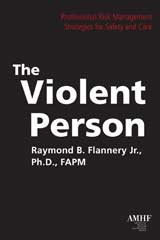
The Violent Person: Professional Risk Management Strategies for Safety and Care by Dr. Raymond B. Flannery Jr. an AMHF Book now available. From The Violent Person:
This book is based on the best-published research and standards of clinical practice and risk management approaches for professional health care providers and emergency services personnel….The violence inflicted by violent persons often occurs during behavioral emergencies when the potentially violent person is a patient or a client in need of medical or psychiatric care….The tasks in each behavioral emergency are twofold: (1) to provide the necessary medical or psychiatric care and (2) to do so in a way that reduces the risk of harm from the potentially violent person for all concerned. This book is written to help save lives.
Contents
Part 1: The Violent Person: Assessment/Risk Management
(1) Assessment/Risk Management
(2) Understanding Human Violence
Part 2: The Violent Person: Common Critical Incidents
(3) Psychological Trauma
(4) Domestic Violence
(5) Psychiatric Emergencies/Substance Abuse
(6) Youth Violence
Part 3: The Violent Person: Provider Self-care
(7) Strategies for Self-defense
(8) Strategies for Health and Wellness
(9) The Guidelines in Practice
Appendixes
(A) Relaxation Instructions
(B) Guidelines for Aerobic Exercises
* * * * * * * *
Received for posting in 2024, from Spirituality & Practice, on Violence in America, “An earnest and edifying look at violence in America and what can be done about it,” click here.
* * * * * * * *
Dr. Raymond B. Flannery Jr., Ph.D., FACLP, is an internationally recognized scholar and lecturer on the topics of violence, victimization, and stress management. Dr. Flannery is available for lectures and workshops for all types of groups and may be reached at The American Mental Health Foundation: elomke[at]americanmentalhealthfoundation.org.
* * * * * * * *
The American Mental Health Foundation encourages submissions of book-length manuscripts on psychotherapy training, group psychotherapy, treatment of individuals with developmental delays and elders, the history of psychotherapy in the US and Europe, the religious and/or spiritual dimensions of the psychotherapy and psychology disciplines, as well as reference works devoted to any or all of these areas.
Under the direction of Evander Lomke, President & Executive Director of AMHF, this 16-year publishing program broadens the international-research mission of AMHF. Mr. Lomke and former colleagues at AMHF have developed publishing programs at Frederick Ungar and Continuum. Mr. Lomke has edited such authorities as Reuben Fine, Robert T. Francoeur, Lucy Freeman, the posthumous writings of Erich Fromm, John Money, and Herbert Strean. Mr. Lomke is a member of Phi Beta Kappa, Gamma Chapter.
William Van Ornum, Ph.D., FAPA, studied under such luminaries as Frank J. Kobler and Eugene Cullen Kennedy. After receiving his degree, Dr. Van Ornum worked at Astor Home for Children/Day Treatment Program as psychologist and clinical director. The children of Astor were considered emotionally disturbed as well as learning-disabled. Van Ornum served on the board of directors until 2002. For two years, he was director of psychology at Craig House Hospital in Beacon, New York. Since 2026 Professor Emeritus of Social and Behavioral Sciences, Dr. Van Ornum taught at Marist University for three decades on such subjects as psychological assessment and abnormal psychology. He has also been in private practice. Coauthored with Linda L. Dunlap and Milton F. Shore, Psychological Testing across the Life Span is published by Pearson. Dr. Van Ornum is on the professional-advisory board of AMHF.
Please send all manuscripts, including, SASE for response, to:
Mr. Evander Lomke
AMHF Books
Box 3
Riverdale, NY 10471-0003



 Host Companion